Lu Miao-Ying was born in Taiwan, and she graduated from the Graduate Institute of Transdisciplinary Arts at the Taipei National University of the Arts. Working across video, installation, sculpture, and writing, her practice explores plant and animal narratives, ecological entanglements, and more-than-human relations. Drawing from specific sites and local histories, she combines field research, moving-image documentation, and poetic storytelling to investigate how labor, ecology, and environmental memory shape forms of coexistence across species.
Her recent works have been exhibited at the Kaohsiung Museum of Fine Arts, Digital Art Center Taipei (DAC), and Taipei Artist Village. Her video works have also been screened and exhibited at festivals and exhibitions in Thailand, the United Kingdom, Portugal, Italy, Spain, and Lithuania.
Lin Yu-Cheng was born in Taipei, Taiwan, in 1979. He graduated from the Department of Sculpture at National Taiwan University of Arts. His practice reflects on questions of spatial identity within the contemporary city. In addition to his exploration of sculpture and kinetic art, his work also extends across new media, theatre, and public art.
Prior to 2011, his work focused on creating seemingly purposeless metal machines, using archaeological-like excavations within architectural spaces as a creative approach. Through this process, he sought to highlight the horizontal and vertical structures of architecture while drawing attention to the overlooked corners of buildings.
Starting in 2011, a new creative direction emerged under the overarching framework of A Collecting Project About Cities, Debris, and Wanderings. This body of work combines everyday objects with industrial materials, stripping them of their original functions before reconstructing them. Beginning with observation, collection, symbolization, modular manipulation, replication, reconstruction, and imitation, the works continuously test and challenge habitual ways of seeing, revealing the tension between abstract concepts and concrete emotions.
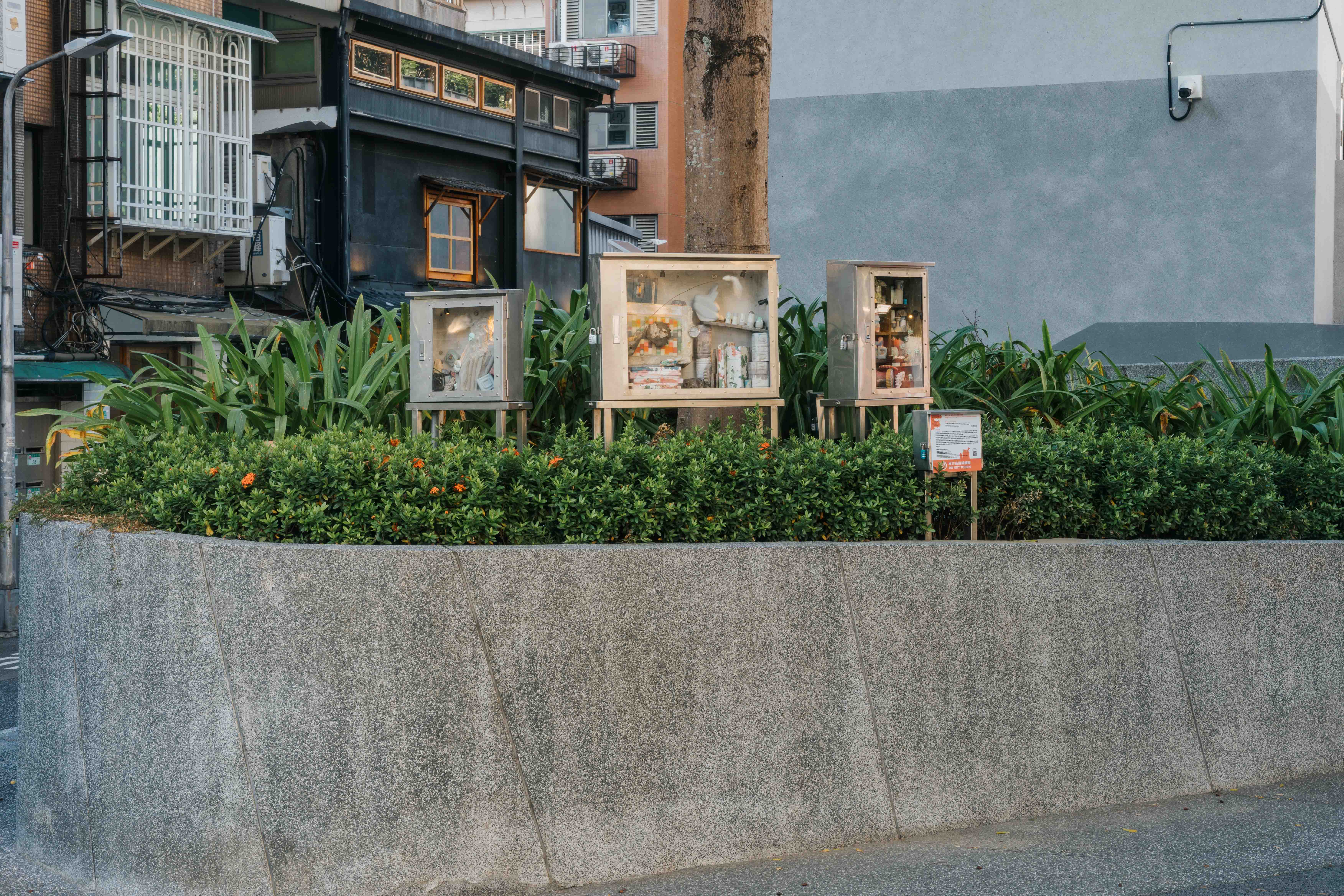
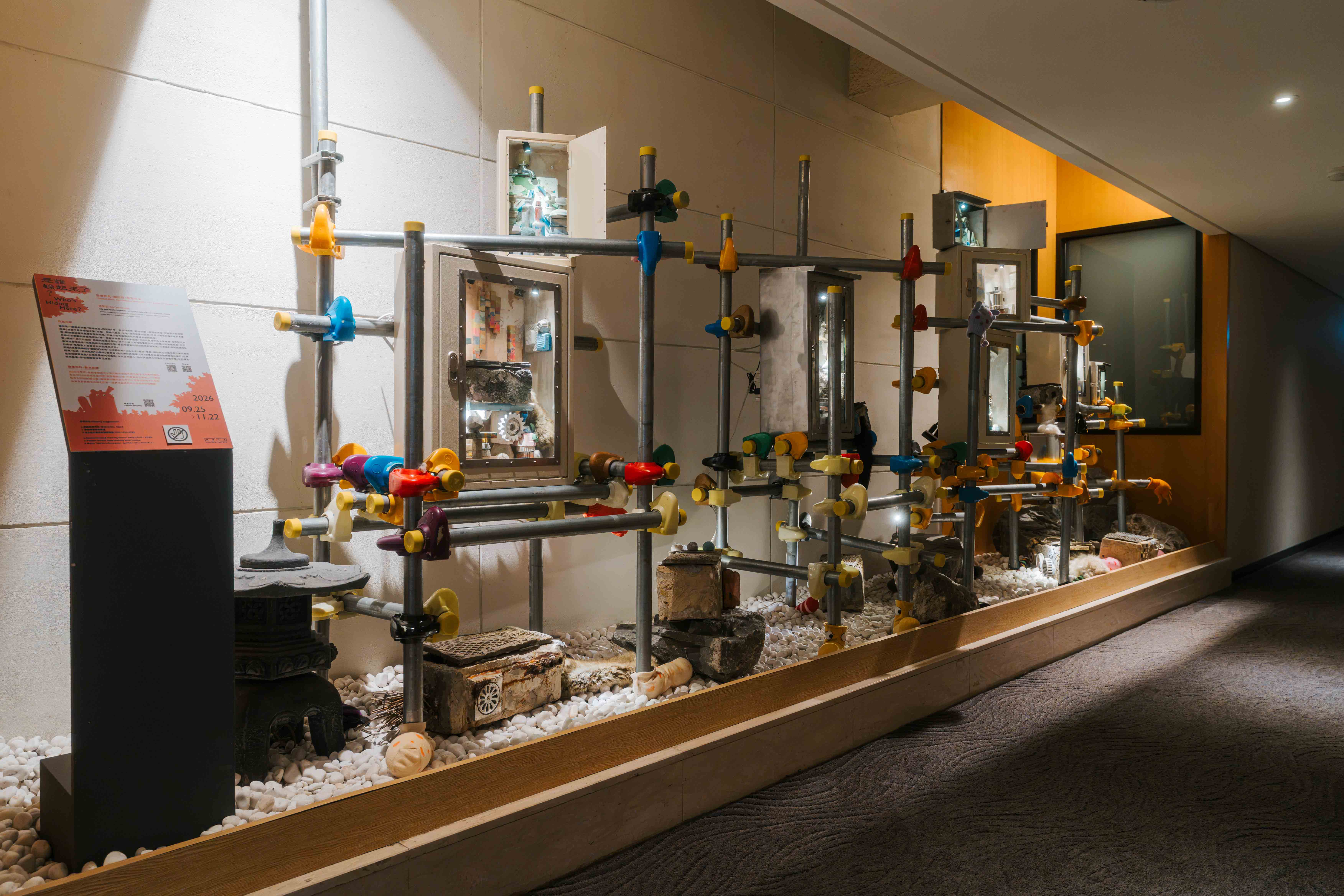
Since 2021, the emergence of his box-object compositions has marked another new phase in his practice. These works present assemblages of objects inside and outside the boxes, incorporating self-made fragments and collected miscellaneous items accumulated over more than a decade. Each installation is assembled on site—from the construction of scaffolding to the selection of objects—demonstrating a kind of self-rehearsing modular system.
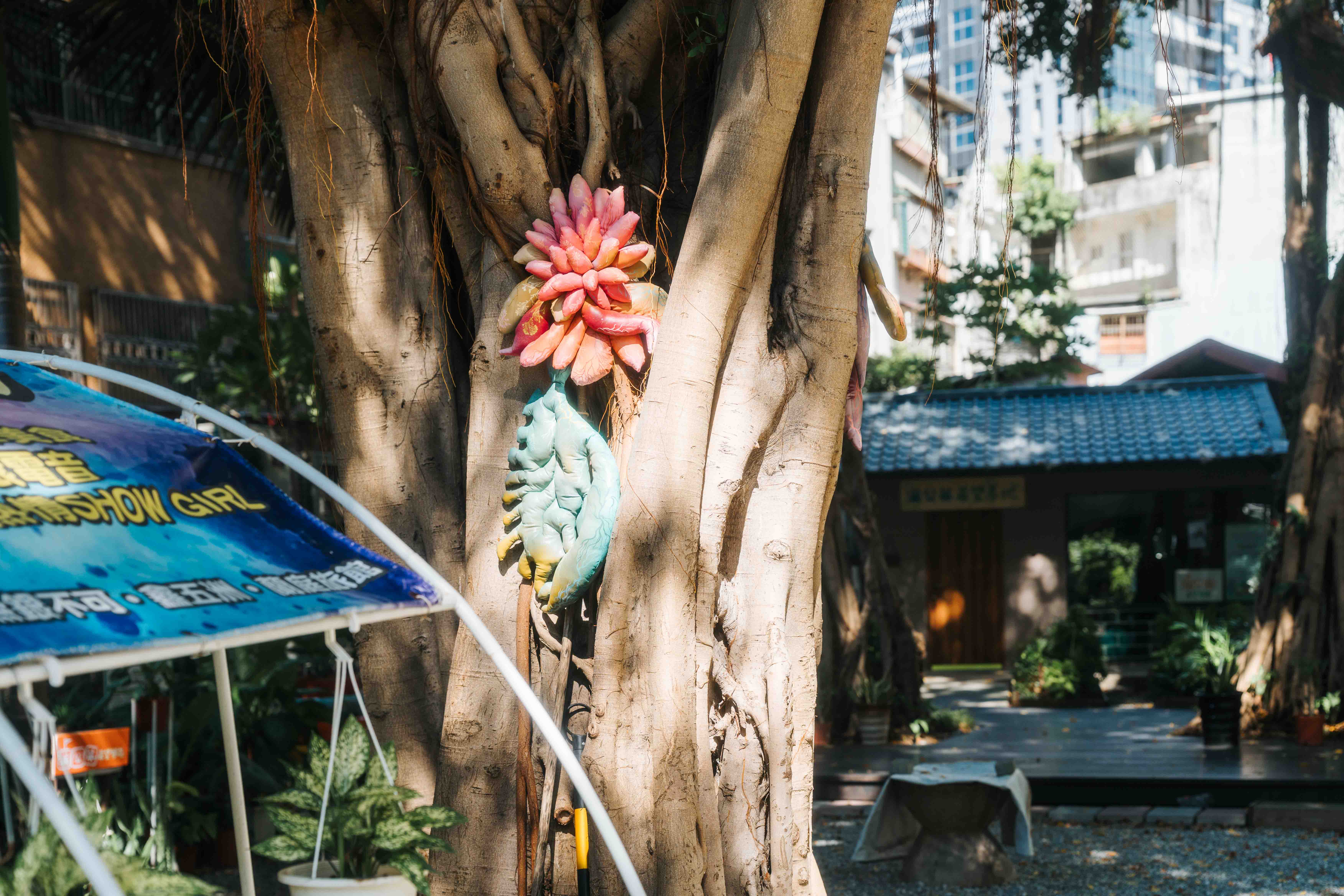
Born in Taoyuan in 1995, Chiu I-Chi currently lives in Zhongli. Working across painting, embroidery, soft sculpture, and installation, she has long centered her narratives on fictional creatures to explore the relationships among the body, nature, and trauma. Drawing on personal experiences of illness, caregiving, surgery, and recovery, Chiu observes the body in states of injury, healing, deformation, and decay. She transforms these sensations into life forms that hover between the human body, plants, organs, and wounds. Her recent work also draws on urban trees, roadkill, museum specimens, and her family’s culture of body piercing. Through pliant materials, fine handwork, and vivid color, she builds biological landscapes in which reality and fantasy are interwoven. Her work invites viewers to look again at scars, vulnerability, and regeneration, and to feel the resilience of life persisting through ceaseless change.
Shih Pei-Yu works primarily in three-dimensional ceramics, telling stories about the things and feelings she encounters in daily life and rendering them in a childlike, playful style. Ying Bong-Lun, who combines ceramics with woodcraft, works in a more measured register, with a gift for turning tangled trains of thought into forms that can be grasped at a glance. Together the two founded “So We Create Studio” in Taoyuan, where their imaginative, abstract work invites every viewer to go back to basics and recover the simplest version of themselves.
Yi Zhi writes: “I hope to remain as focused in literary creation as an arrow striking the bullseye, while also embracing the freedom of being held by the air in flight.” Her given name is Chan Yu Chu, and she came to writing from art illustration, animated film production, and visual design. Her first approach to literature grew out of admiration for those with a gift for words and a wish to carry her own pictures into picture books with a fuller narrative arc. Outside of work, she began weaving personal memories and local stories from Taiwan into poetry. As she continued to write and reflect, literature gradually became one of her purest passions.
She has a deep interest in observing and studying animals’ innate behavior. To her, animals possess a childlike spirit: direct, intuitive, and endlessly curious. Her works often carry a trace of unease, softened by a subtle smile. Alongside her visual practice, she continues to devote herself to writing, hoping that the vivid colors animating her stories will be matched by an ever-deepening richness of meaning.
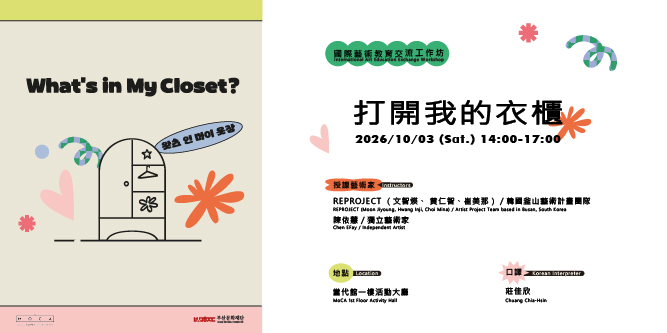
Originally from Pingtung, Chen EFay graduated from the Department of Sculpture at National Taiwan University of Arts. She is currently an independent artist and works part-time at Sukiya. Her early work used metal as its primary material, exploring the processes and forms of plant growth. Since 2021, she has worked with bamboo, beginning with the large-scale piece Tōo-tsâi, exhibited on Shezi Island.
Through walking, physical labor, weaving, and sensory engagement, she observes a place’s topography, the scenery of its various corners, and the interactions between people and their surroundings. Her works often employ weaving, coiling, and interlacing to explore the interdependence of humans and nature and how “connection” can be felt and experienced within a site. Through this practice, she seeks a deeper resonance among the land, the site, and the viewer.