By Yan Xiao-Xiao (Chief Editor of ARTCO & ARTouch)
Outside: Opening and Adjustment
Each time I step into an exhibition of Lai Chih-Sheng’s works, it feels like a light adventure. The term “light” is used because the clean and minimalist space does not impose a heavy or impactful visual experience, nor does it require understanding and analyzing complex backgrounds. Quite the contrary: the audience needs to set aside the usual imagination and knowledge constraints associated with “artworks” and bring these questions to engage with the space:
What am I looking at here? Where is the “work”? What can I do here?
This approach places professionals and the general public on the same starting line—professionals might gain insights by connecting with minimalism and conceptual art. However, a more suitable method is to tap into the most intuitive and direct perceptions and imaginations to observe and feel. This is where the “adventure” lies.
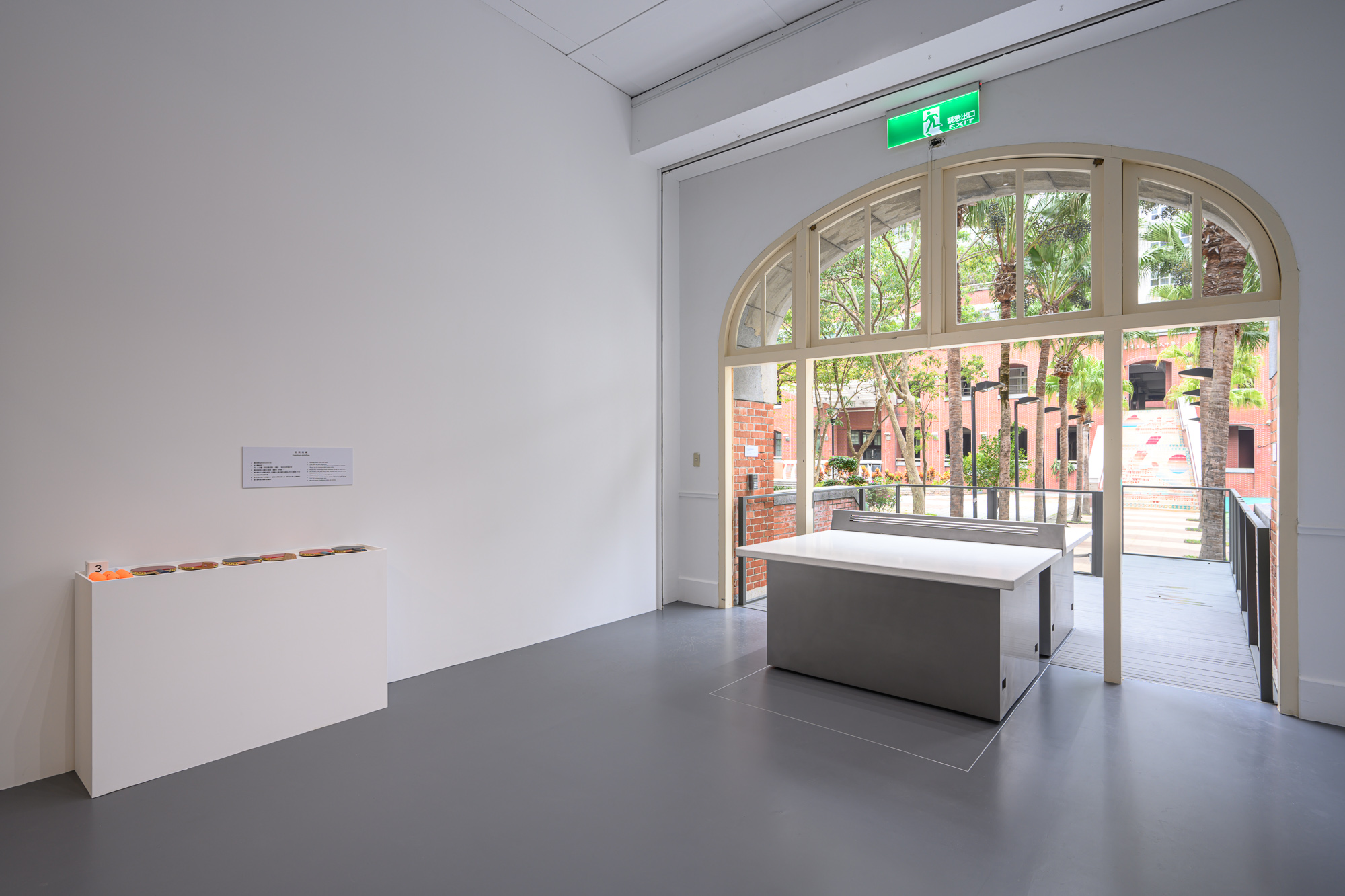
This year, Lai Chih-Sheng was invited to create on-site at MoCA Taipei. After examining various spaces within the museum, he took advantage of the unique feature of the shared historic building between the Museum and Jian Cheng Junior High School, originally Kensei Shōgakkō (Jian Cheng Elementary School) from the Japanese colonial period. He opened a long-closed door facing the museum entrance, “borrowed” a piece of land from the school, and built a small terrace extending into the campus, inviting the audience to enter and then step out of the art museum. In addition, he temporarily removed the door leading to the campus and placed a table tennis table, half indoors and half outdoors. During the planned year-long project, both museum visitors and junior high school students and faculty could play, linger, or enjoy the view here and even reach out to touch a fountain palm tree trunk within the campus from the extended platform.
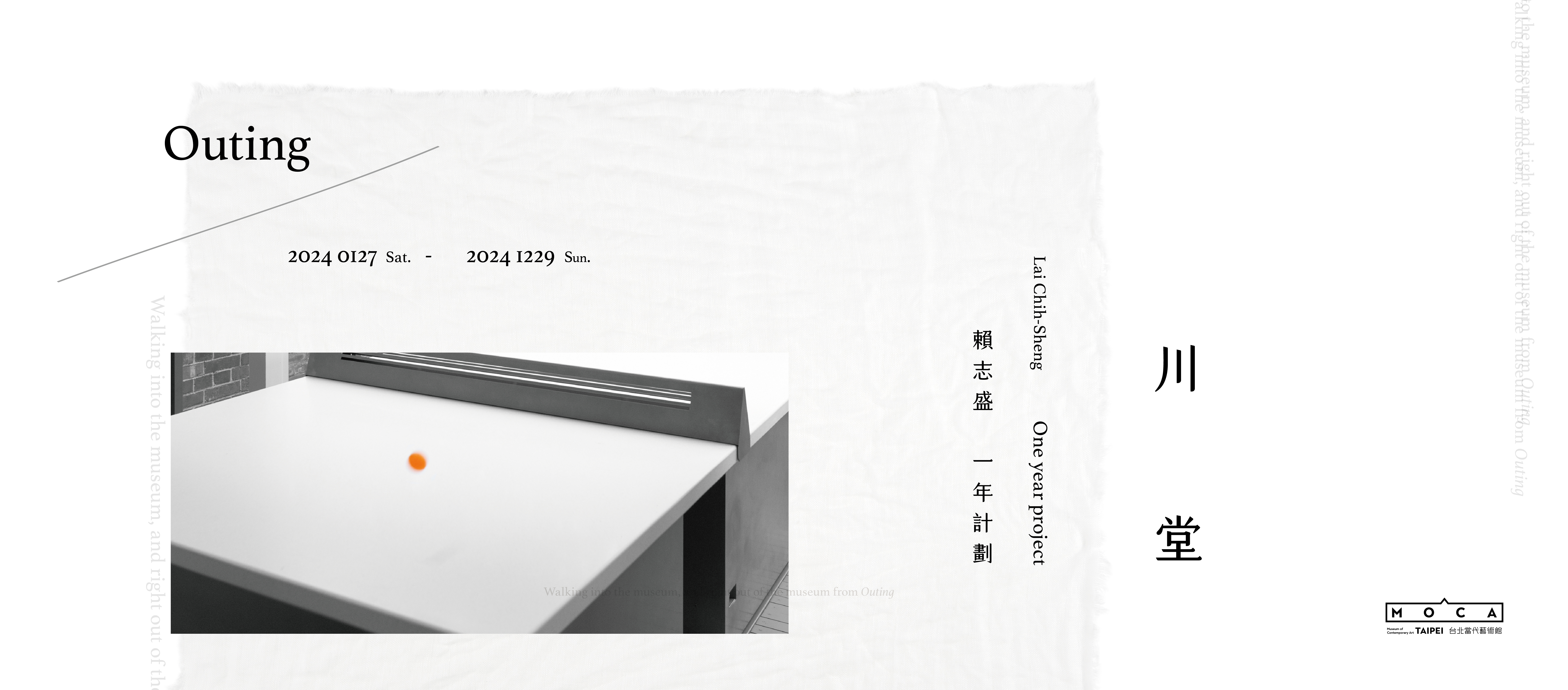
Lai Chih-Sheng named this one-year project “Outing” (Chuan Tang, meaning “entrance hall”). With a few words and verbs, he outlined the essence of the “entrance hall,” where each action conveyed a meaningful message. The Japanese architect Kondo Juro (1877-1946), who contributed significantly to Taiwan’s modern urban architecture, designed and planned the building with red bricks, gray tiles, a bell tower, and classical axial symmetry. This time, we had the opportunity for a more complete experience. This project includes a series of “opening” actions, whether physical, spatial, imaginative, spiritual, or metaphorical.
For visitors to MoCA Taipei, especially those regulars who have long been accustomed to peering into the campus through the windows on one side of the corridor, it is the first time they can step into the campus and stand on the terrace to look back at the other facade of the museum building, which was almost impossible to see before. This space has always existed and is easily imagined, but this time, the “co-construction of the museum and campus buildings” is no longer just a statement in the introduction but becomes a historical context that can truly be experienced at any time. Even the “Feng Shui axis” of Taipei City, leaning against Mount Qixing and rotated 13 degrees clockwise from the meridian, is symbolically suggested and opened up.
The title of this project has also been thoughtfully considered. The Mandarin title, Chuan tang, with the first character of 川 (river) rather than 穿 (through), emphasizes the meaning of “continuously flowing,” indicating that it is not only people who come and go but also natural light and air entering the room and the sounds of the ball rising and falling on the paddle and table, and even occasionally flying into the campus.
In his past works, Lai often delineates new boundaries and adds new dimensions to spaces, thereby changing the range of activities or observations within the space. To this end, he has developed different methods for each specific space with its unique characteristics, such as outlining boundaries (Life-Size Drawing at Eslite Gallery, 2011), adding new planes to create new relationships between people and spaces (Scene at Eslite Gallery, 2015, Canton Flower Bridge at Observation Society, Guangzhou, China, 2018, Drifting Sandbar at Our Museum(Yo-Chang) Art Museum, NTUA, Taiwan, and Border presented in various countries and cities), threading with certain materials (Stop by at Edouard Malingue Gallery, Shanghai, China, 2019 and Vertical II at Crane Gallery, Kaohsiung, Taiwan, 2019, both using water), and revealing the invisible with specific techniques (Beyond Untitled at Eslite Gallery, 2015 and Stop by II at ALIEN Art Centre, 2020). In each space, Lai makes subtle changes, perhaps best described by the more delicate term “adjustment.” These changes result in attention or pauses at easily overlooked or previously inaccessible places, revealing the existence of another space.
Sometimes, his actions that challenge systematic frameworks are more apparent. For example, at the 2022 TAIPEI DANGDAI Art Fair, at Kiang Malingue’s booth, he used a carpet with dimensions 1% (5 cm) larger in length and width than the floor, squeezing out a wrinkled surface, with nothing else in the booth (Redundant). Similarly, in 2023, he held a solo exhibition titled “It’s a Quiet Thing” at Kiang Malingue in Wan Chai, Hong Kong. Both the venue of the art fair and the city of Hong Kong are among the world’s most valuable spaces. When we think about how they can accommodate such nearly futile operations, a new sensory space is generated.
In Outing, we can almost recognize all the above actions applied to the space. The new boundaries delineated are not only “opening” but also “extending,” naturally changing the range of human activities and creating a seamless transition between two distinct spaces. Unlike some past works where invasive methods like drilling holes for water to drip and connecting water pipes to link adjacent but unseen spaces, the materials threading through Outing are light, air (wind), and people (relationships), allowing visitors to step onto the terrace and enjoy the view in the most relaxed and natural way.
Each time Lai Chih-Sheng creates on-site works, he more or less faces situations beyond his complete control, with some tangible or intangible elements escaping and returning to the works unexpectedly. In the interactive installation of Outing, he adopts a more relaxed and symbolic strategy: table tennis is designed for at least two participants with back-and-forth interaction, which provides a specific method of interaction and symbolizes the encounter between art viewers and museum staff and the junior high school teachers and students—the audience stepping over the fence to retrieve the orange ball from the campus, students collecting scattered balls and returning them to the museum, or even playing ball in the campus without immediately returning it. The artist is pleased to watch the trajectory of these orange balls. He even says it would also be nice if one or two of them were unnoticed in the soil under the trees.
Time is another dimension that Lai Chih-Sheng’s works often address. Four years ago, his project Closer at Taipei Fine Arts Museum took nearly two years to incubate a new relationship between the audience and the space. Now, it is foreseeable that in the year of Outing, MoCA Taipei and Jian Cheng Junior High School will be mutually permeable, creating new relationships not only between the audience and the space but also between people. Another ingenuity regarding the dimension of time is hidden on the table tennis table. Lai Chih-Sheng invited several young artists, including Hsu Jui-Chien, to create a plain terrazzo tabletop, solid yet easily stained. It is half indoors and half exposed to the elements. Imagine the difference on its surface after a year.
In many moments, the works leave the artist and develop their unique forms.
Inside: Those That Touch and Shape Us
Some artists can still bring surprise and inspiration even when we have a general grasp of their past creative context and basic methods; their works often touch on more indescribable things that repeatedly emerge in certain moments—Lai Chih-Sheng is one of them.
After roughly outlining Outing and the fragmented context shaped by Lai’s past works and their impact on the external world, I will now attempt to further explore, albeit superficially, what his works evoke within the viewer’s heart.
If we carefully reconsider the inner workings of Lai’s acts of adjusting and opening spaces and relationships, a question arises: What are the purposes of those “adjustments” and “openings”? There seems to be no specific “purpose.” Even if the door from MoCA Taipei to Jian Cheng Junior High School remains permanently closed, it does not affect the two institutions’ routine operations or prevent them from occasionally communicating with each other— they can simply enter and exit through different doors. However, in the adjusted and opened time and space, multiple operations of defamiliarization often lie dormant, making us reconsider the taken-for-granted things in life, adding moments of wrinkles that allow us to pause and reflect on the world we live in.
Many overlapping, intertwining, and permeating experiences exist in daily life; a place, a city, and a landscape all have similar layers. Lai Chih-Sheng’s works create wrinkles in time and space, or perhaps “excess” spaces and new dimensions, suggesting unconventional but familiar things, allowing those different layers of experience to “reunite.” Just as in 2015, when he polished the exhibition space walls at Eslite Gallery, revealing the layered design of different exhibition walls and even wall works over the years like annual rings (Beyond Untitled), Outing evokes memories of history overlapping in the same space. More often, his works abstractly make the ranges of one’s bodily senses, imagination, and knowledge become fluid and uncertain. These memories and consciousness are collective, not belonging solely to specific individuals; meanwhile, the materials threading through are mostly soft (like water and air), and the elements of these materials are nothing but earth, water, fire, and wind—the essential components of all things and the fundamental makeup of humans—making the back-and-forth movements between these layers of experiences more natural and seamless.
Interestingly, we often see in Lai Chih-Sheng’s works and exhibitions that the final presentation is not necessarily what he initially conceived, with some even vastly different. His proposals frequently form varying degrees of tension with the institutions he faces. His flexibility and balance between the permissible and impermissible, the core spirit and external form, provide us with more opportunities to repeatedly ponder through experiencing his works and being in the spaces he has adjusted, how they, through various “reunions,” shaken the “unusual” spaces retained within each individual’s interior and reveal some subtle but powerful things that come from nowhere during purposeless moments, things we all need to cope with the constantly defined framework by grand structures.